
An interesting report on social media usage trends throughout Europe.
The bottom line?
1. Internet usage is still largely task-based. News consumption, research & information gathering prior to purchase and staying in touch with friends are the most frequent activities.
2. We research EVERYTHING - from snack foods to holidays - online.
3. Comfortable strangers. The fabric of our social network is changing significantly. In the UK, for example, people stay in touch "face-to-face" with 21.4 people, while they stay in touch online with 49.3 people.
So what about women and social media?
It's definitively a new matriarchy! See "Information is beautiful"
Women now outnumber men on:
Facebook: 57 percent women users.
Twitter: 57 percent women users.
Flickr: 55 percent women users.
When we look at the influence of social media on Generation-Y women's behavior (view the stats here), we see exactly how powerful a communication tool social media networks are becoming...!
Thursday
Social media: the new matriarchy?


The female economy according to Harvard Business Review

There's a very interesting article circulating amongst M2W experts out there. It was published by Harvard Business Review recently and it shares some shockingly concrete facts about women as a market.
"As a market, women represent a bigger opportunity than China and India combined. So why are companies doing such a poor job of serving them?"
Read that again: a bigger opportunity than China (1.3 billion) and India (1.17 billion) COMBINED.
And yet, as the article says: so many companies still think of women as a "niche" market. And those that don't - the ones that sell all the female products such as lipsticks, dresses and shoes - still mostly do a poor job of it.
You can read the full article here.
Friday
The $5 Trillion Opportunity.
The Boston Consulting Group recently surveyed more than 12,000 women in 22 countries about their needs, wants and expectations. For those still in doubt as to whether they should be taking women's expectations into account in their marketing strategies, the press release's sub-title may do the trick: "Emerging $5 Trillion Opportunity Exists for Companies that Systematically Understand and Respond to Women's Needs for Time, Value, Emotional Connections."
According to the BCG study companies are failing to meet the needs of women in five key areas:
1. poor product design and customization for women;
2. clumsy sales and marketing efforts;
3. an inability to address women's need for time-saving solutions;
4. an inability to provide a meaningful hook and differentiation, and
5. failure to develop a community around the brand.
Banking, cars, technology: it's still a man's world.
The study also points out that women still feel left out in the cold by many traditionally male industries such as banking & investment, automotive and technology.
o 49 percent of women said investment companies need to do a much better job of understanding and meeting their needs.
o 48 percent of women are disappointed with the auto industry and cars.
o 47 percent are disappointed with banks; 45 percent with life insurance; 42 percent with physicians and 39 percent with car insurance.
We've highlighted the fact that these industries still all too often ignore women in blogposts and newsletter before.
To those companies that are listening: opportunity knocks! Use your window of opportunity before others wake up!
Thursday
Why social media matters - so much!
The control of products, services and advertising is increasingly shifting to the consumer. Gone are the days of creating an award-winning creative ad and placing it in all the right places. Gone are the days of you telling the consumer what they need. They are telling you. Just ask Motrin or Dell(a).
According to a Forresters research report released recently, "The distinction between traditional and innovative marketing techniques will become significantly more pronounced as the socially driven online communities continue to gain momentum".
...And to quote the CEO of one of Belgium's most aggressively innovative digital TV stations: "The 30" TVC has no future. We have to be realistic and face the fact that it will disappear within the next ten years."
Those are some disruptive theories. But I firmly agree. Marketing as we know it is dead.
I've blogged about it in the post "The death of PR", and will go a step further: social media IS the new PR - especially when marketing to female consumers.
Brands that want to market their products/services to women will need to integrate social media in their marketing strategy.
Why do I place so much emphasis on social media in marketing to women?
Because women treat information gathering as a textured and interactive process – one that includes gathering AND exchanging information – both online and offline - with friends and peers and support networks.
Women also re-evaluate their selection criteria throughout the information gathering process. While men tend to identify a few key selection criteria and then buy a product that matches those criteria to offer them a “good solution”, women will keep adding and amending their criteria - listening to opinions and advice, evaluating your product offering against a complex, nuanced set of criteria - and shop until they find a product that offers “the perfect solution”.
Social media will continue to affect and change the way in which consumers interact, with brands and with each other.
Below the future of social web, as detailed in a research report released by Forresters a few weeks ago.
The Five Eras of the Social Web:
1) Era of Social Relationships: People connect to others and share
2) Era of Social Functionality: Social networks become like operating system
3) Era of Social Colonization: Every experience can now be social
4) Era of Social Context: Personalized and accurate content
5) Era of Social Commerce: Communities define future products and services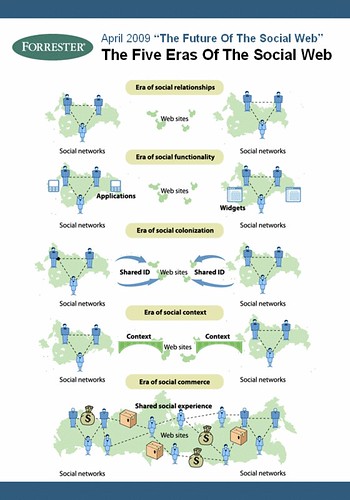
Astute marketers will take note and educate themselves now on social media and how it impacts their business and their customer - ahead of the pack.
Read more here
Friday
Automotive marketing to women

Here's an interesting statistic: it takes men an average of 13 weeks to buy a new car. It takes women on average 18,5 weeks. This longer decision-making cycle highlights the fact that women have a more complex decision-making process that has her gather more information and incorporates many more selection criteria than men do. USA research shows that women today influence more than 85% of all auto, tire and service buying purchases, and yet 74% of those surveyed feel misunderstood by automotive and tire marketers. One wonders why most automotive brands still don't make a bigger effort to understand and woo their female customers.
Show me her car and I will tell you who she is.
In a recent article on Tire Review, Insight Farms shared some interesting research about how women use and feel about their cars. "Women ‘wear’ their cars. The exterior is the face we show others. The interior is our ‘authentic self.’ The front seat is our workspace. The back seat is the kids area and garbage bag. The trunk is ‘where things go to die.’"
Other sound bites on marketing to women:
• Women are looking for substance – you have to stand for something. Seventy-eight percent of women say leading companies are driven by values.
• "Edgy," "excess," "too much fun" and "living life large" are being replaced by "giving back." Women want to know what you stand for.
• Instead of asking "do I want it?" she's asking "do I need it?" In the current climate, women are hoping for the best but preparing for the worst. Women right now are looking for value, but that doesn't necessarily mean they are looking for cheap.
• A woman's buying process is longer. Good enough isn't good enough – she's looking for the perfect answer.
• She is more expensive to acquire, but cheaper to keep. Because she's already invested more time in her decision, she's more confident in that decision. There's a higher psychological cost if she walks away.
• If she complains and you handle the complaint and satisfy her, she's even MORE likely to recommend you than if she had a good experience. Make it easy for her to complain. She is trying to communicate with you and solve the problem with you.
Good to know: women share a negative experience with a brand or product with an average of 23 people. A positive experience is shared with an average of 9 people (vs only 3 for men!).
Tuesday
The Girl Effect
A friend of mine, who knows that I'm taking part in a rally through northern Africa to raise money for an organization that helps women to start their own businesses, sent me this video last night. It's by the Nike Foundation and is called "The Girl Effect".
Nike has made a lot of mistakes and done a lot of wrong (like most companies)...What's important is that they are doing something about it. They're making amends. Their leading by example. They're investing time, energy, resources and money. Every little bit helps, so let's give them credit for that.
Thursday
Co-creation: now that's a great idea!

Co-creation - the process during which a company involves an external group of people in (a part of) the innovation process of a product or service - gets its first public event!
Held on June 24th in The Netherlands, the first ever Co-creation event is under the auspice of RedesignMe - "the first platform where communities and companies collaborate on (new) products and services".
As marketeers, we all too often stay in our 'gilded corporate cages', instead of actively involving our clients, prospective clients or other relevant stakeholders in the development of products or services. While I worked at Barco Media & Entertainment as marketing manager, we did so on a few occasions (in 2004! imagine!) so I got to see the benefits of involving users of your product first-hand during the R&D process. Seeing the proactive participation of users, the free exchange of ideas, the 'free' advice and ultimately the results of these collaborations, I am a firm believer in the theory that a product developed with direct input from its consumer is a better one than the product developed in the vacuum of our labs.
Tuesday
Female consumers: the cure for recession blues?
The past few months have been busy, to say the least. We're working on an exciting new project for a major international DIY brand, and we're in the midst of a PR campaign for Milner, not to mention other projects with which we're in full preparation. And between all the work, there are the presentations I'll be giving at VEPEC tomorrow night and JUMP on Thursday. I can confirm what this article in The Economist highlights: it seems to be a true marketing-to-women explosion out there.
It's funny that it took a recession to get business to start taking its female consumers more seriously. And its interesting to see who's seeing this as a 'quick fix' opportunity and who's really committed to their female consumers for the long run. Of course I have to mention Nike, who have done great work marketing to women for years, and again do so with the "Here I am" campaign, which features great ads with slogans such as "My butt is Big" and the "I have Thunder Thighs".
But then there's also McDonalds who's suddenly sponsoring New York Fashion Week. There's a major disconnect between brand perception and the PR tool (sponsoring a fashion week that showcases skeletal models...) in my opinion. Unfortunately for McDonalds, this effort goes against one of the fundamentals of smart marketing to women: be real. Or as one of Belgium's top female bloggers, Clo says: "being who you really are instead of trying to be something or someone you are not."
And then there's Porsche, which launched a 4x4 (as did Jeep with its Compass) designed 'for women'.
As the Economist article states, this constitutes "gender bending", which is not always to the benefit of the brand. Au contraire, mostly it will work against the brand. And I'd like to stress here that "gender bending" is NOT the same as smart marketing to women. Designing a product specifically for women is often not a good idea. Women never asked for a 4x4 "for women" (it comes across a little condescending to me...as if women can't drive 'normal' SUVs). What's the answer then, you may wonder? Porsche and Jeep should have involved women during the design & development process of their original SUVs. If manufacturers (of all kinds of products) involve women throughout the entire NPI process - from R&D through design to marketing, they will get a balanced mix of input, which will ultimate lead to a product that ALSO satisfies the needs of female consumers, and that's what smart marketing to women is all about.
Which leads us to the question: what's the future of smart marketing (to everyone)? This article presents an answer which at first may seem a little scary, but which also presents an enormous opportunity..
"I predict female consumers will take on an increasing role with brands and businesses-the next women's liberation movement when women will co-manage brands with the official brand manager, business owner or marketing director. This partnership will exist with brands that dare to let go and share the steering wheel with consumers."
A multitude of consumers who willingly and on their own initiative provide feedback, contribute ideas, give suggestions? That's like employing an entire new marketing department! One that has extensive experience with your product to boot! Wow! Now if that isn't food for thought for all marketers...!
Wednesday
Learn from the Future
Last night I attended a VEPEC event where some of Belgium's foremost business leaders from the publishing & media world and politicians discussed the current crisis and its effects on our industry: disastrous to say the least. Some publishers said that income generated by advertising was down by as much as 30% (at least that's what they'll admit to in public). The CEO of the Alfacam Group and founder of the soon to launch television channel "EXQI" went even further, saying that "the 30-second spot will disappear completely in the foreseeable future."
Now if these two small snippets from an evening marked by unspoken unease and questions filled with fear or bewilderment don't spell "dawn of a new world order", then I don't know what it will take to wake people up.
Some people have been "awake" to the new realities for a while, including MIT professor Otto Scharmer. Author of "Theory U", Scharmer is an action researcher who creates innovations in learning and leadership that he delivers through classes and lectures across the globe.
In this 7-minute video he succinctly explains what the revolutionary statement "learn from the future" means. As I watched the video, it struck me that the requirements and method for innovation were based on a right-brain approach, of course also known to be more 'female' in that it requires unbounded qualitative patterns rather than linear sequences.
Suffice it to say that I am curious to see how a largely hierarchal, linear, male-dominated business world will respond to these new non-linear rules for true innovation.
Monday
Welcome to the future of business: 100 companies that will change the world

I've been saying it to anyone who will listen: the current economic crisis will change the way in which we do business - for ever.
But I'm certainly not the first to notice the fundamental societal shifts that are currently shaking up our lives. The signs have been there for all to notice: our unbalanced lifestyles that have lead to countless broken families and stress-related afflictions, the youth of today being dubbed the "work-to-live, not live-to-work generation" or the almost irreversible damage our "Me-myself-and-I" globalized consumerism has caused over the past few decades. Let's be honest: how much longer did we think this excessive and self-obsessed way of living could last?
How will these shifts impact the way we live and do business? Fundamentally, if you ask me.
We will need to (re)find a balance between that has been lost for many decades.
What a refreshing, inspiring discovery it was when I came upon Striding Out's "Future 100" list this morning. The Future 100 list is a compilation of talented young entrepreneurs aged 18-35 who demonstrate entrepreneurial flair and innovation in progressing a responsible business venture. Responsible business is defined as one which demonstrates a balance between economic, environmental and social goals to achieve ultimate business success.
"The future of our world is in the hands of individuals who are committed to generating commercial and ethical returns. Challenging economic times can offer opportunities to question the way we operate as both a business community and a society. We are looking for the 'Future 100' young entrepreneurs who are changing the face of everyday business and improve commerce's impact on the wider world," says Striding Out founder Heather Wilkinson.
Some of the companies that caught our attention:
http://www.thisisredbutton.co.uk/ - design company developing products exclusively for the Aid and Humanitarian markets.
Fair Gift - Fair Trade gifts from Asia, Africa and South America.
TribeWanted - inspirational holidays with a purpose
LM3Online - helps you measure your organization's economic contribution to its community.
Women Like Us - helps Mom's reintegrate into the working community
The Hub - connecting 'the new entrepreneurs' with each other across the globe.
Journeys For Change - takes extraordinary leaders on interactive expeditions to learn from the world's most inspiring social and environmental entrepreneurs.
Tuesday
Marketing to Moms Must Read.

Rasorfish and Cafemom recently issued a report called "Digital Mom".
It contains a wealth of information about how technologies are affecting the behavior of moms - from how they parent, socialize and keep in touch, to how they shop.
Reading the report really brings home the fact that the way in which moms communicate and whom they trust is changing fundamentally. As marketeers, it is imperative we understand how to leverage emerging technologies as well as the growing social influence of the digital mom in a changing media landscape.
So, if you're marketing your product/service also to Moms (and really, who isn't?), then you should read this report!
Monday
Survey: Help Us Better Meet Your Business Travel Needs

Ad!dict Creative Lab is a global think-tank that brings together over 4,000 creatives from around the world on innovation and design challenges that need a broader perspective.
They're currently doing a survey on business travel. More specifically: the likes and dislikes thereof with seasoned business travelers. Over the past few decades, women have also become frequent business travelers, and as such, it is important that we share our likes and dislikes - from a woman's perspective!
The team at Ad!dict would really appreciate it if you could take the short 3-minute survey here.
As soon as the project wraps and the findings & recommendations are made public, we'll share a selection of them here! So, stay tuned in the coming months...!
HOT OFF THE PRESS: launch of WOMEN-omics.com website

WOMEN-omics ( www.WOMEN-omics.com), provides exclusive global reporting on women's growing economic impact on companies and countries, and aggregates the best information, ideas, and insight in the field, updated daily. A one-stop portal, the site is designed for corporate leaders, top executives, policymakers, journalists, researchers, business schools, and women in the workplace. The site brings together news updates, case studies, rankings, exclusive CEO profiles, research reports, statistics, and other resources.
MUSE COMMUNICATION CONTRIBUTES!
As one of Europe's only communication agencies specialized in marketing-to-women, Muse Communication was also asked to contribute an article for the launch of the new portal. Titled "Marketing Needs a Woman's Touch", you can find it here.
Thursday
Nothing will be the way it used to be.
The way in which we do business has been changing steadily for a while now. The impact of the changing world in which we live keeps becoming clearer every day. It's a scary and uncertain time in which to do business, for the changes we are experiencing are fundamental and far-reaching. This clip, sent to me by my friend Caroline over at RollingTalks, is spot-on in its analysis of the forces that are increasingly affecting business today.
For those brave enough to run with the bulls in these uncertain times, the clip also contains a few great inspirational pointers that can help you get (or stay) ahead of the pack!
Wednesday
December Newsletter Out Today!
We've put together our best newsletter yet - a compilation of the best and the worst (and the funniest) in the world of marketing to women. Chock full of videos, insight and inspiration, we hope you enjoy this review of 2008.
As always, we would love to hear your feedback. Agree? Disagree? Have a different campaign to suggest?
Don't forget - to sign up, email us at newsletter@musecommunication.com! Enjoy.
Thursday
The end of wrap-rage as we know it.

This phrase almost made me snort* my coffee all over my keyboard this morning: "Frustration-Free™ Packaging"
When I mentioned the remote possibility of frustration-free packaging here in the office, everyone became very curious, because, lets face it: who hasn't cursed trying to open the hard-plastic packaging of a new toothbrush or waded through reams of wire-tie, styrofoam and bubble-wrap to get to that brand-new remote control toy car. Wrap rage...so prevalent, it's right up there with road rage!
I've always said and I'll say it again: great marketing (also to women) starts with a great product. And packaging is of course part of the product...Actually: it's a consumer's first experience with the product!
As consumer, I can no longer count the number of times I have cursed trying to open a a shrink-wrapped package (with my teeth), or the number of times I have felt totally guilty for buying a 50ml jar of facecream inside a box large enough to ship an elephant.
So: kudoz to Amazon CEO Jeff Bezos for starting the "Amazon Frustration-Free™ Packaging" initiative. With it, the company joins forces with a list of companies including Mattel, Fisher-Price and Microsoft to deliver products in smaller, easier-to-open packaging.
On behalf of at least a few million consumers, I would like to thank you for taking the first step, Jeff...this can only lead to less frustration and less guilt on the consumer's side! (Not to mention the money you guys will save by using smaller/lighter and less packaging!)
*Courtney's recommended word this morning. No animals or humans were injured during the unfortunate coffee incident. The keyboard survived too (it's a Mac...of course.)
Friday
Marketing during the recession.

I think we can call it official: the economy is a stumbling, faltering mess.
The growing rumbling of the recessional snowball can be heard loud and clear on both sides of the Atlantic now, and there are no signs that it’s going to miraculously disappear any time soon. In fact, this may be one of the most fundamental marco-economical shifts in many decades, and I can’t help but think that the magnitude of the possible changes makes us all freeze like rabbits in a car’s headlights. We’re not quite sure where it’s going and we have no idea how it will end.
“Recession” is a word that also causes marketeers sleepless nights. Suddenly, nothing across any of the four “Ps” is the way it was yesterday. Consumers have a different mindset about spending. Price elasticity curves change. Managing the company balance sheet takes priority above all else (especially marketing), and as marketeers we’re expected to do much more with much, much less.
Of course a recession affects different market sectors in different ways and to different levels, so a one-approach-fits-all for recessional marketing doesn’t exist. However, here are some key truths that hold true for all brands during a recession:
THE CONSUMER:
Economical uncertainty leads to uncertainty on a personal level. Consumers worry about their jobs, their household budgets, their savings. They tend to cut back on discretionary spending, postpone larger purchases, trade down or buy less. As a recent Harvard Business School article said: “Yesterday’s must-have features become today’s can-live-withouts”.
Seth Godin said: “When times are good, buying things is a sport. It's a reward. The story we tell ourselves is that we deserve it, that we want it and why not? When the mass psychology changes and times are seen as not so good, the story we tell ourselves changes as well.”
The answer? Address the consumer’s changing priorities and needs in your communication. Try to strengthen the relationship with your customer by offering great price/quality, stellar customer service and keep your brand top-of-mind with the right messages and communication efforts.
PRODUCT:
Gimmicks are out. Quality is in. Focus on your product’s reliability and performance. Reassure your consumers that you will continue to focus on quality. Products that address the new realities of the consumer – both on a product level and a communication level can do well in these uncertain times.
PRICE:
It goes without saying that most consumers become more price conscious during a recession. I’m not saying change your pricing strategy completely, but in the current economic climate, price elasticity will decrease in most sectors and consumers are more likely to shop around for the best deals. Offer consumers temporary price promotions, bulk buying discounts or bundled product packages to appeal to a value & budget conscious mind-set.
PLACE:
Don’t forget that your channels suffer too during hard times. It may prove impossible to retain your channel breadth & depth, but it would be wise to evaluate partnerships and support your strongest partners. Training them on your products and providing them with the support to promote your products will lead to a stronger relationship and will see you take market-share at a time when everyone else is cutting back!
PROMOTION:
“Successful companies do not abandon their marketing strategies in a recession; they adapt them” says Harvard Business School.
One of the most forgotten advantages of a recession is the fact that marketers have more bargaining power with media outlets. With marketing spend drastically cut, spots open up for the taking at reduced prices – paradise for astute negotiators!
Although marketing is about creating a long-term sustainable advantage, promotion during economically difficult times can focus on increasing short-term sales too. Instead of campaigns focusing on corporate image, now’s the time to invest in cross selling and up selling tactics, point-of-sale actions, direct marketing activities or channel promotions to increase revenue.
As I wrap up this article, the news has just come in that Tokyo’s NIKKEI index fell to its lowest point in 21 years. These uncertain times are the stuff nightmares are made of, for consumers and marketers alike.
The best advice I’ve had to date? Don’t panic. Stay focused. Spend frugally. Be ready to adapt swiftly.
Tuesday
Fantastic Lingerie Marketing
Have you seen the new Playtex campaign? What a wonderful example of marketing lingerie to women in an appropriate, fun way! Every woman can relate to this!
Thursday
Do You Believe in the Power of One?
I like to think one person CAN make a difference – in the real world, the virtual world – even the corporate world. One of my favorite books is The Power of One by Bryce Courtenay. It’s a tale of inner strength, making strong personal connections and being as real and authentic as possible. 
These same core beliefs; inner strength, real friendship and authenticity, don’t merely belong in fiction but also apply to the world we live in, including the virtual one. The concept of living meaningfully resonates with a wide, varied online audience. Find non-profit jobs and volunteer opportunities on idealist.org, read tips on simplifying life at zenhabits.com, learn how to live greener with idealbite.com or watch inspiring videos at karmatube.org.
The Internet allows beauty and idealism to prosper in a variety of forms, most notably with the strength of the people using the Internet. Just like the book Groundswell by Li and Bernoff states, the power of the people has never been more evident than online. A great organization to harness this power and altruistic enthusiasm is the inventive Carrotmob. I saw a ten-minute video a few months back of their work in CA. Here’s the shorter four minute clip
The Concept: Carrotmob approached a number of convenience stores in one town to find the shop willing to donate the highest percentage of income from the sales of one day to a charity. The motivation for the stores to participate was the promise of extra customers courtesy of Carrotmob promotions.
End result? HUNDREDS of customer flooded the chosen store on the set date, exceeding all expectations of the shop owner, giving them a boon of profit PLUS a big chunk of money was donated towards making the store more energy efficient! 
Reason it works? It’s being able to do good by doing what you were planning on doing anyway, without any extra effort. We all have to buy things. Given the choice of buying batteries and a carton of juice at a regular shop or at a shop that offers the same thing, for the same price but gives a portion of your money to a good cause? No contest! It’s going with green with no effort. It’s being better with out having to break a sweat.
It’s the power of one by simply being you! What a brilliant concept.
I see the Carrotmob idea – motivating corporations to do well – easily catching on. It empowers the individual. It gives control back to the person making the purchase. And it potentially increases the profit of the company. Everybody wins!
What do you think - can this idea work across the world? In the corporate jungle or in globalized commerce initiatives? Would you make a conscious effort to make your purchases with companies donating towards a worthy cause?
Monday
What Rock Chicks can teach us

I'm back from two days at Rock Werchter, one of Europe's biggest summer festivals. I came back with more than a sore back, blistered feet and the feeling that a russian second world war tank has just driven over my body. I also came back with two of the most valuable lessons about why women buy into brands.
Lesson number one "BE REAL" came in the form of The Gossip - a US band lead by front singer Beth Ditto.
Beth, unapologetic, in-your-face and rauncheously female, played a rocking set to a crowd of thousands of women who clearly loved every single voluptuous inch of her. There were no diva allures about Beth. She jumped down to talk to the crowd in the middle of the set; climbed (rather ungraciously) back onto the podium, sang from the bottom of her heart, played on a fan's trumpet, gave it back to him and thanked him!
What did Beth give her fans that we as marketeers can learn from?
- What you see is what you get. No bullsh*t, no false promises, no promises she doesn't deliver on. Au contraire...she exceeded our expectations by delivering what we expected and more, and being respectful to her audience.
Lesson number two "SURPRISE US AND SHOW US YOU CARE" was delivered by Dutch Diva Anouk.
Anouk took a crowd of almost eighty thousand people by complete surprise when, in the middle of one of her biggest hits, her little 4 year old boy (wearing ear-mufflers and sporting a red plastic guitar) appeared shyly on the side of the stage. And what did she do? She stopped singing, and told her band to stop playing. She then walked over to her son, bent over and asked him if he wanted to play a song with her. Holding the mike to his guitar, she accompanied him, in the smallest, most fragile mother's voice, as he strummed halting, incoherent notes on his plastic red guitar. After almost 3 minutes of this (and a crowd going absolutely wild) she resumed her song. I don't think there was one single person in that whole crowd who minded that interruption one single bit. And it didn't end there. Throughout her performance, her three sons kept running across the stage, huddled in ear-muffs and warm fleece jackers. Every now and again, she stooped to pick up one of them, planted a quick kiss and resumed her set.
What a woman...Clearly she wanted her children with her while she was away from home. What she gave us though, without realizing, were 3 reasons to like her even more.
To Beth, and Anouk I dedicate this post. And thank them: for being real, for being so likably human, for wanting to connect, when they could have settled for giving a just another performance.
And in this lies the lesson all marketeers should heed: marketing is long past the point of being a song-and-a-dance performance. Heed your consumer...they want more. Actually, they want all of you. And that is where the future of successful marketing lies: forming real connections, respecting your consumer, being real and giving back. That is what consumers really buy in to.


