
I'm back from my Africa-adventure and ready to dive back into the wonderful world of marketing and marketing-to-women!
What a better way to start off again than by reintroducing Sarah Haskins and her "Target Women" spoof project. Sarah has been in the news lately as "
Here is her latest spoof "Hot Chicks!"
Showing posts with label consumer insights. Show all posts
Showing posts with label consumer insights. Show all posts
Thursday
How to appeal to Hot Chicks (101).


Monday
HELP! Get me out of here!

The Summer sales season represents a true shopping nightmare to many.
While some love the thrill-of-the-chase of a good bargain (as do I), the drawbacks of the shopping experience are just too great for others to even bother. Crowded stores, the frenzied tug-of-wars over flimsy summer tops, long cues at the fitting rooms and check-out counters....It is a nightmare many are quite willing to skip!
I am currently writing our next newsletter, which is about enhancing the in-store shopping experience for women. Over the past few days I have spent quite some time thinking about what I call "fitting room politics": how our experience in the store - and especially in the fitting rooms - can make or break a sale.
Here are my top 3 fitting room "peeves":
1. Uncleaned floors - Nr 1 killer of a positive impression of a brand! All that shiny marble goes to waste when the floors are littered with dust, hairs and clothing fluff! The worst? 7 out of 10 stores have fitting rooms that are not clean!
2. Lazy sales personnel. The kind that expects you to return the items you've just tried on to the correct shelves in the stores (a favorite in Belgium stores!) instead of doing so for you (with a smile!).
3. Fitting room basics: a well-closing curtain or door, a few hooks, a stool (these days often considered a luxury, it seems), flattering lighting.
Getting it right in the fitting room is of the utmost importance: it is probably the ONLY place in which your customer thinks clearly about her purchase. The more comfortable she is here, the more likely she is to buy!
Five creative ways to enhance her fitting room experience:
Food for thought: if your customer saw only the fitting room, would she know what store she is in?
Besides the basics such as natural lighting, clean floors, enough hooks, a stool (yes please!) or a scarf to protect garments, there are several other creative ways in which to enhance the impression your brand will leave on her in the fitting rooms.
1. Brand it! Use the space to reinforce your brand. Repeat brand colors in the curtain, color of the walls. And add your logo!
2. Surprise them! Beautiful, crazy or cute clothes hooks and an eye-catching stool can change the entire look-and-feel of a fitting room. And how about filling those bare white walls with life-size posters of your latest collection?
3. Sooth the senses! A comfortable temperature (20 - 23 degrees), appropriate music (not too loud!), an in-store fragrance machine...
4. Guidance: size charts or that season's color combination charts in fitting rooms are no luxury. These small gestures make your customer feel important and more relaxed!
5. The "pièce de résistance"? A buzzer for staff assistance!
For while most women don't like being trailed by sales staff through a store, they do appreciate some help with getting another size or color when they're in the fitting room. And that's where they'll be making their decision, so isn't it just then that we want to make the experience as pleasant as possible?
And last, but certainly not least: take care of her shopping companions. A seating area with some comfortable chairs, a few magazines and a bowl of sweets is a small investment that will make her feel less rushed when she shops.
Thursday
Why social media matters - so much!
The control of products, services and advertising is increasingly shifting to the consumer. Gone are the days of creating an award-winning creative ad and placing it in all the right places. Gone are the days of you telling the consumer what they need. They are telling you. Just ask Motrin or Dell(a).
According to a Forresters research report released recently, "The distinction between traditional and innovative marketing techniques will become significantly more pronounced as the socially driven online communities continue to gain momentum".
...And to quote the CEO of one of Belgium's most aggressively innovative digital TV stations: "The 30" TVC has no future. We have to be realistic and face the fact that it will disappear within the next ten years."
Those are some disruptive theories. But I firmly agree. Marketing as we know it is dead.
I've blogged about it in the post "The death of PR", and will go a step further: social media IS the new PR - especially when marketing to female consumers.
Brands that want to market their products/services to women will need to integrate social media in their marketing strategy.
Why do I place so much emphasis on social media in marketing to women?
Because women treat information gathering as a textured and interactive process – one that includes gathering AND exchanging information – both online and offline - with friends and peers and support networks.
Women also re-evaluate their selection criteria throughout the information gathering process. While men tend to identify a few key selection criteria and then buy a product that matches those criteria to offer them a “good solution”, women will keep adding and amending their criteria - listening to opinions and advice, evaluating your product offering against a complex, nuanced set of criteria - and shop until they find a product that offers “the perfect solution”.
Social media will continue to affect and change the way in which consumers interact, with brands and with each other.
Below the future of social web, as detailed in a research report released by Forresters a few weeks ago.
The Five Eras of the Social Web:
1) Era of Social Relationships: People connect to others and share
2) Era of Social Functionality: Social networks become like operating system
3) Era of Social Colonization: Every experience can now be social
4) Era of Social Context: Personalized and accurate content
5) Era of Social Commerce: Communities define future products and services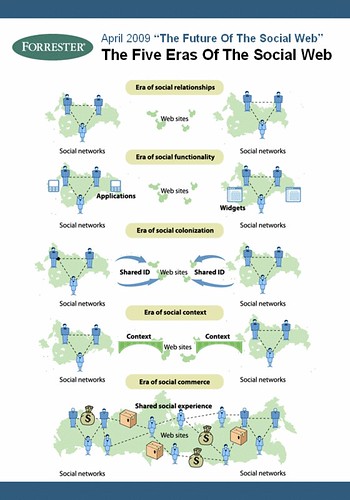
Astute marketers will take note and educate themselves now on social media and how it impacts their business and their customer - ahead of the pack.
Read more here
Monday
Welcome to the future of business: 100 companies that will change the world

I've been saying it to anyone who will listen: the current economic crisis will change the way in which we do business - for ever.
But I'm certainly not the first to notice the fundamental societal shifts that are currently shaking up our lives. The signs have been there for all to notice: our unbalanced lifestyles that have lead to countless broken families and stress-related afflictions, the youth of today being dubbed the "work-to-live, not live-to-work generation" or the almost irreversible damage our "Me-myself-and-I" globalized consumerism has caused over the past few decades. Let's be honest: how much longer did we think this excessive and self-obsessed way of living could last?
How will these shifts impact the way we live and do business? Fundamentally, if you ask me.
We will need to (re)find a balance between that has been lost for many decades.
What a refreshing, inspiring discovery it was when I came upon Striding Out's "Future 100" list this morning. The Future 100 list is a compilation of talented young entrepreneurs aged 18-35 who demonstrate entrepreneurial flair and innovation in progressing a responsible business venture. Responsible business is defined as one which demonstrates a balance between economic, environmental and social goals to achieve ultimate business success.
"The future of our world is in the hands of individuals who are committed to generating commercial and ethical returns. Challenging economic times can offer opportunities to question the way we operate as both a business community and a society. We are looking for the 'Future 100' young entrepreneurs who are changing the face of everyday business and improve commerce's impact on the wider world," says Striding Out founder Heather Wilkinson.
Some of the companies that caught our attention:
http://www.thisisredbutton.co.uk/ - design company developing products exclusively for the Aid and Humanitarian markets.
Fair Gift - Fair Trade gifts from Asia, Africa and South America.
TribeWanted - inspirational holidays with a purpose
LM3Online - helps you measure your organization's economic contribution to its community.
Women Like Us - helps Mom's reintegrate into the working community
The Hub - connecting 'the new entrepreneurs' with each other across the globe.
Journeys For Change - takes extraordinary leaders on interactive expeditions to learn from the world's most inspiring social and environmental entrepreneurs.
Thursday
Nothing will be the way it used to be.
The way in which we do business has been changing steadily for a while now. The impact of the changing world in which we live keeps becoming clearer every day. It's a scary and uncertain time in which to do business, for the changes we are experiencing are fundamental and far-reaching. This clip, sent to me by my friend Caroline over at RollingTalks, is spot-on in its analysis of the forces that are increasingly affecting business today.
For those brave enough to run with the bulls in these uncertain times, the clip also contains a few great inspirational pointers that can help you get (or stay) ahead of the pack!
Friday
Marketing during the recession.

I think we can call it official: the economy is a stumbling, faltering mess.
The growing rumbling of the recessional snowball can be heard loud and clear on both sides of the Atlantic now, and there are no signs that it’s going to miraculously disappear any time soon. In fact, this may be one of the most fundamental marco-economical shifts in many decades, and I can’t help but think that the magnitude of the possible changes makes us all freeze like rabbits in a car’s headlights. We’re not quite sure where it’s going and we have no idea how it will end.
“Recession” is a word that also causes marketeers sleepless nights. Suddenly, nothing across any of the four “Ps” is the way it was yesterday. Consumers have a different mindset about spending. Price elasticity curves change. Managing the company balance sheet takes priority above all else (especially marketing), and as marketeers we’re expected to do much more with much, much less.
Of course a recession affects different market sectors in different ways and to different levels, so a one-approach-fits-all for recessional marketing doesn’t exist. However, here are some key truths that hold true for all brands during a recession:
THE CONSUMER:
Economical uncertainty leads to uncertainty on a personal level. Consumers worry about their jobs, their household budgets, their savings. They tend to cut back on discretionary spending, postpone larger purchases, trade down or buy less. As a recent Harvard Business School article said: “Yesterday’s must-have features become today’s can-live-withouts”.
Seth Godin said: “When times are good, buying things is a sport. It's a reward. The story we tell ourselves is that we deserve it, that we want it and why not? When the mass psychology changes and times are seen as not so good, the story we tell ourselves changes as well.”
The answer? Address the consumer’s changing priorities and needs in your communication. Try to strengthen the relationship with your customer by offering great price/quality, stellar customer service and keep your brand top-of-mind with the right messages and communication efforts.
PRODUCT:
Gimmicks are out. Quality is in. Focus on your product’s reliability and performance. Reassure your consumers that you will continue to focus on quality. Products that address the new realities of the consumer – both on a product level and a communication level can do well in these uncertain times.
PRICE:
It goes without saying that most consumers become more price conscious during a recession. I’m not saying change your pricing strategy completely, but in the current economic climate, price elasticity will decrease in most sectors and consumers are more likely to shop around for the best deals. Offer consumers temporary price promotions, bulk buying discounts or bundled product packages to appeal to a value & budget conscious mind-set.
PLACE:
Don’t forget that your channels suffer too during hard times. It may prove impossible to retain your channel breadth & depth, but it would be wise to evaluate partnerships and support your strongest partners. Training them on your products and providing them with the support to promote your products will lead to a stronger relationship and will see you take market-share at a time when everyone else is cutting back!
PROMOTION:
“Successful companies do not abandon their marketing strategies in a recession; they adapt them” says Harvard Business School.
One of the most forgotten advantages of a recession is the fact that marketers have more bargaining power with media outlets. With marketing spend drastically cut, spots open up for the taking at reduced prices – paradise for astute negotiators!
Although marketing is about creating a long-term sustainable advantage, promotion during economically difficult times can focus on increasing short-term sales too. Instead of campaigns focusing on corporate image, now’s the time to invest in cross selling and up selling tactics, point-of-sale actions, direct marketing activities or channel promotions to increase revenue.
As I wrap up this article, the news has just come in that Tokyo’s NIKKEI index fell to its lowest point in 21 years. These uncertain times are the stuff nightmares are made of, for consumers and marketers alike.
The best advice I’ve had to date? Don’t panic. Stay focused. Spend frugally. Be ready to adapt swiftly.
Monday
No Sex Please, We're Women.

I was recently asked by De Morgen's weekend supplement WAX, to write an opinion piece on the use of gender stereotypes and nudity in advertising. I called the article "No sex please, we're women".
No Sex please, we’re women.
I’m a woman and I don’t like sex. I want everything around me to be nice, perfect and clean and I want it to be completely politically correct. And above all: no sex, please.
That at least, is the way I understood women to want things after reading a press statement by the European Parliament’s women’s rights commission stating that all stereotypes in advertising should be outlawed and a few days later being confronted with a recent study by KU Leuven about the effects of nudity in advertising.
It’s interesting to see how our lawmakers and ad-makers alike still grabble with what it is that women want.
European lawmakers, under the watchful eye of Ms Svensson, on the one hand, call for a ban of all gender stereotypes in advertising. A woman cleaning the kitchen, a man polishing his car. Svensson wants us to realize that these images play up (or down) to stereotypes about the role of men and women - and in doing so undermine equality between the sexes. I agree with Svensson when she says that "gender stereotyping in advertising straitjackets women, men, girls and boys by restricting them to predetermined and artificial roles that are often degrading, humiliating and dumbed down for both sexes".
Boys should be allowed to play dress-up with their dolls without Dad having a heart attack. Girls should be allowed to come home with a blue eye after a scrap in the schoolyard without Mom becoming hysterical about the reputation of her little girl. Women should be able to admit to enjoying one-night stands, and men should be allowed to cry during Sex in the City.
While I agree with Svensson that stereotypes can help confine people to boxes they don’t fit into, I don’t support her solution to the issue. The recommendation that governments police the advertising industry by creating regulatory bodies to monitor ads and introduce a “zero-tolerance” policy against stereotyping and degrading imagery fills me with a faint sense of George Orwellian dread. I wonder how the concepts ‘stereotypes’ and ‘degrading’ will be defined for me, and by whom.
What if the government doesn’t like the ad for Opium perfume featuring a stunningly naked size 42 Sophie Dahl in a pose suggesting masturbation? Provocative? Yes. Degrading? No. And will they disapprove of the legendary Diet Coke commercial featuring a bare-chested male construction worker? This ad too plays perfectly to a gender stereotype – but it worked oh so tantalizingly well... 
Having grown up in South Africa during the apartheid infested eighties, it may be my fear of an overbearing authority speaking, but the question of who will decide what is acceptable or not, and whether these definitions will change with the government of the day, keep me awake. Government-sponsored media control not only affects freedom of speech, it also strips us of our personal responsibility as individuals to help effect change. That is much worse for society than stereotyping a woman fawning ecstatically over her whiter-than-white washing.
The problem with the acceptability of stereotypes lies in this: many stereotypes are in part based on reality. Is a stay-at-home mom a stereotype or a reality? Is a young, muscular construction worker a reality or a perpetuated reality? Distinguishing between reality and what is perpetuated as reality is a very grey area I would rather not have policed by the government du jour.
Which brings me to that other famous grey area in advertising: nudity. A recent study researched the impact of nudity on economic behavior and found that – surprise, surprise: nudity works. Well, at least it does for men. When it came to the way it affects women’s behavior, answers became a lot more vague. From “…een belangrijke groep vrouwen is ook gevoelig voor beelden van schaars geklede mannen” to “…[vrouwen] zijn even goed opwindbaar, en zullen wellicht ook veranderingen in hun economisch gedrag vertonen, maar dat zal eerder gebeuren in situaties waar de seksuele prikkel via de tastzin wordt geleverd in plaasts van via het oog.”
I’m still trying to understand these findings. Which women exactly fit into this “belangrijke groep vrouwen”? And if, as the study says, women are sensitive to images of scantily clad men, then what about me liking the Opium ad featuring a squirming Ms Dahl?
…And God forbid we consider the implications of women being more affected by a sexual impulse delivered through touch. I’m just not ready for a sensual fondle by the sales assistant at the local Zara!
But seriously: does nudity in advertising affect women? Yes, it does. I know the stereotype says that women don’t like sex or that women are not affected by nudity, but the reality is: we do and we are! We like our Diet Coke Man as much as we like our naked Sophie Dahl. But for us, nudity for nudity’s sake doesn’t work. It must add value to the message. If it sells us an empowering emotion, if it makes us giggle, if it holds up an inspiring, sensual mirror, if it conveys unabandoned freedom or playful eroticism, then yes, we are affected.
So instead of heading down the slippery slope of government-sponsored media censorship or silently allowing misperceptions about women to persist, here’s my recommendation: let’s support Ms Svensson’s suggestion that the advertising industry instead give prizes to companies who do the most to break down what it sees as gender 'straitjackets'. But let’s also take up our own responsibility as individuals and speak up about what we will and won’t accept, what we like or don’t like.
Do I like degrading images of women? No, I don’t. But I like the fact that some government could be deciding for me what is acceptable and what not much less.
Shouldn’t we as women and consumers be wielding our own conscience and using our wallets to show the advertising industry and big business what we do and don’t like, what we will and will not tolerate? For although it is a government’s task to draw global boundaries, it remains our individual responsibility to stand up and count in shaping positive and constructive images that accurately reflect our society.
Friday
Wanted: second-hand woman for sheer driving pleasure

Every time I look at this ad for BMW's selection of "Premium Used Cars", I just can't believe my eyes. (hat tip to Copyranter, where I found the ad)
HELLO? Is there anyone home at BMW Marketing...?
The questions that keep popping up (please do excuse the pun in this case) in my mind are:
WHO THE HELL SIGNED OFF ON THIS AT BMW?
a) Is this guy really in marketing?
b) How many of his brain cells were actively participating in helping him make the decision on this one?
WHO IS THE CREATIVE GOFER THAT DELIVERED THIS LITTLE PIECE OF MENTAL MASTURBATION?
Do they really pay him at BBDO Greece? And was there no-one more strategic to review this concept?
In my opinion this ad is the perfect example of "how stupid ads are made". The answer? One long chain of unbelievably short-sighted decisions made by people who really shouldn't be paid to be in marketing or advertising.
The last person to leave the BMW marketing team, please: switch off the lights.
Monday
What Rock Chicks can teach us

I'm back from two days at Rock Werchter, one of Europe's biggest summer festivals. I came back with more than a sore back, blistered feet and the feeling that a russian second world war tank has just driven over my body. I also came back with two of the most valuable lessons about why women buy into brands.
Lesson number one "BE REAL" came in the form of The Gossip - a US band lead by front singer Beth Ditto.
Beth, unapologetic, in-your-face and rauncheously female, played a rocking set to a crowd of thousands of women who clearly loved every single voluptuous inch of her. There were no diva allures about Beth. She jumped down to talk to the crowd in the middle of the set; climbed (rather ungraciously) back onto the podium, sang from the bottom of her heart, played on a fan's trumpet, gave it back to him and thanked him!
What did Beth give her fans that we as marketeers can learn from?
- What you see is what you get. No bullsh*t, no false promises, no promises she doesn't deliver on. Au contraire...she exceeded our expectations by delivering what we expected and more, and being respectful to her audience.
Lesson number two "SURPRISE US AND SHOW US YOU CARE" was delivered by Dutch Diva Anouk.
Anouk took a crowd of almost eighty thousand people by complete surprise when, in the middle of one of her biggest hits, her little 4 year old boy (wearing ear-mufflers and sporting a red plastic guitar) appeared shyly on the side of the stage. And what did she do? She stopped singing, and told her band to stop playing. She then walked over to her son, bent over and asked him if he wanted to play a song with her. Holding the mike to his guitar, she accompanied him, in the smallest, most fragile mother's voice, as he strummed halting, incoherent notes on his plastic red guitar. After almost 3 minutes of this (and a crowd going absolutely wild) she resumed her song. I don't think there was one single person in that whole crowd who minded that interruption one single bit. And it didn't end there. Throughout her performance, her three sons kept running across the stage, huddled in ear-muffs and warm fleece jackers. Every now and again, she stooped to pick up one of them, planted a quick kiss and resumed her set.
What a woman...Clearly she wanted her children with her while she was away from home. What she gave us though, without realizing, were 3 reasons to like her even more.
To Beth, and Anouk I dedicate this post. And thank them: for being real, for being so likably human, for wanting to connect, when they could have settled for giving a just another performance.
And in this lies the lesson all marketeers should heed: marketing is long past the point of being a song-and-a-dance performance. Heed your consumer...they want more. Actually, they want all of you. And that is where the future of successful marketing lies: forming real connections, respecting your consumer, being real and giving back. That is what consumers really buy in to.
Tuesday
My Monday Memo (on a tuesday)
There's so much happening in the M2W arena at the moment, a quick between work update on some must-reads:
The second edition of the Muse Newsletter is due out this thursday. Subscribe now if you want to receive it!
Lady Geek - Discovered this a few weeks ago...a wonderful blog about women and technology! Short, quick, funny reads...Bookmark it!
Less is More
Talking of women and technology, check out this interesting report by Jitterbug.
Some topline findings:
Feature Overload is “Out”
o 73% of respondents prefer to pay only for what they believe they will actually use,
compared to only 27% who want all the bells and whistles
o 32% of cell phone users say their current cell phone service has more features than
they know what to do with
Personalized Services are “In”
o 71% said they would be interested in 24-hour access to a personal telephone
assistant who could give them tailored service
o 34% would prefer to have someone else set up their phone features and services for
them
Soon to be released book worth checking out: "Satisfied customers tell three friends, angry customers tell 3,000". More here
(Double or triple those figures - on both positive & negative sides - for women!)
And last but not least, an article on Essensis, the new "wonder" yoghurt by Danone (in Flemish). The product's claim: "feeds your skin from the inside" came across as unbelievable to me when I first heard it. Apparently I'm not the only one.
Time waits for no (wo)man. Gravity is taking hold. No way one yoghurt is gonna solve that. You can read the full article here.
Wednesday
Don't pile on the puppies
 We've been talking about the whole 'fuzzy-warm' issue in marketing to women a lot at the office lately.
There seems to be a widespread perception out there that if a brand wants to connect with female consumers, it's all and ONLY about being able to form an emotional bond with her. We call this the 'fuzzy-warm' syndrome and it makes our hair stand on end.
What frustrates us (and no doubt many, many other women out there) is the concept that a woman is ALL about emotions. (It's a little degrading, you know). Show us a puppy and we'll ohhhh and ahhhhhh over it and of course buy your product. Put the song "Unchained Melody" in your ad and you've got us - for the remainder of our consuming days. Show us a woman having fun, laughing with her girlfriends and we're right there, ready to pull out our over-flowing wallets! Do the warm and fuzzy on us and nothing else matters anymore.
Right.
The current hype surrounding the 'power' of the female consumer means there is great interest, albeit often misguided, in understanding women as consumers. We've all heard it - numerous times: connecting with female consumers emotionally is what it's all about.
I think this needs a little clarification.
Yes, an emotional connection with a brand is important to us. Yes, what Seth Godin said "women don't buy a brand, they join it" can be true.
HOWEVER:
We can only be great brand ambassadors IF many other criteria (and herein lies the crux of the matter!) are fulfilled too.
IF your product delivers what it promises
IF it helps solve the problem I want solved
IF price / quality makes sense to me
IF your service is outstanding - time and time again
IF you give us the information we want: where we want it, when we want it and in all the detail we want it
IF we sense you're being honest and care about more than just us and our money.
And yes, IF your marketing is inspiring and empowering, then we'll connect with your brand.
But don't underestimate us: this is no irrational relationship in which (to use a soppy song) "Love lifts us up where we belong", and one bad experience can still ruin the relationship forever.
Marketeers should remember that women's purchasing behavior is complex, and never based solely on an emotional connection.
As I've always said: Be Brave. Be Real. Show Value.
Monday
About brands, soulmates and online trends
As the week picks up speed on this busy monday morning, I'm picking up on many interesting developments via my Google feed reader. Much is happening in the world-wide marketing (and marketing-to-women) realm that is worth sharing:
I know I keep blogging about social media, but that's because I cannot emphasise the importance of social media enough as part of smart marketing to women campaigns.
An interesting podcast I found on PodTech that details the impact of social media on corporate marketing and PR functions and the latest trends in social media strategy and implementation.
Dating through brands? Now here's a very interesting concept from a marketeers' point of view:
BRAND-MATES is a site where people select as many or as little of the brands that are near and dear to their heart and then they can have some fun searching and connecting to other "like-branded people" to date, find a soul-mate, or maybe just find a friend.
Imagine the data and insights one can collect with this site!
Here's a title that made me stop in my tracks this morning:
"By 2012 women will outnumber men online by more than 8 million!"
Again, these are US statistics, but I think it is safe to assume the same trend will make itself felt here in Europe over the coming years too. Interesting in the excerpt below is the fact that 'women's community' was the most visited and fastest growing internet category! Marketeers, take note!
Author Kaira Sturdivant Rouda on why women are taking over the internet, so to speak:
"The important thing to realize is that women are natural networkers. We’ve been the community builders in the real world since the beginning of time. Think of the most important charities in your community. Most likely they were created by, and continue to be championed by, women. Now, there’s the web. “Women’s community” was the most visited and fastest growing internet category according to ComScore Media Metrix. Women are building community online as never before. And, they are using it for business. Social networking makes business more personal and intuitive. The formally defined lines in society are falling away - and finally, work and family can become more blended."
Sunday
2008 - the year of banishing Bullsh*t

"Naiveté is rare today. Your customer is equipped with a bullshit detector that is highly sensitive and amazingly accurate. And the younger the customer, the more accurate their bullshit detector.
When selling, remember: If you don’t admit the downside, they won’t believe the upside." - Roy H. Willaims.
Can I emphasise this fact enough to my clients? NO.
I advise you to read it again, because it's very, very true...and if you don't believe it, or think you can smooze your way around it with fancy PR or advertising, you're taking a very dangerous Jérôme Kerviel-like gamble with your company's future.
There's a reason why the blog belonging to the man who spoke these simple but very true words is read by many, many people across the world, and the reason is this: without any marketing blah-blah or trendy industry slang, he gets it so very right...it's worth giving up 15 minutes to read his The Monday Morning Memo.
In his post '2008 - The Year of Transition' he highlights what he thinks will be the big consumer trends for the coming years. It's an interesting post, which I think anyone interested in consumer behaviour or marketing...hell, anyone in the business of selling something to someone (that makes all of us) should read it!
Below is an excerpt of the main points. The full post you can find here
Here’s what to remember when selling in 2008:
1. Efficiency is the new Service.
Your customer is saying, “Quality and price and quick, please. I’ve got things to do. Thanks.” Service and selection still matter, but not nearly so much as they once did. Inefficient organizations built on high-touch “relationship” selling will decline. Today’s customer is magnetically drawn to efficiency. This attraction will increase over the next few years.
2. Authenticity is essential.
Listen to the street. “Being cool” has become “Keepin’ it real.”
Naiveté is rare today. Your customer is equipped with a bullshit detector that is highly sensitive and amazingly accurate. And the younger the customer, the more accurate their bullshit detector.
When selling, remember: If you don’t admit the downside, they won’t believe the upside.
3. A Horizontal Connectedness is replacing yesterday’s vertical, social hierarchy. Labels like “white collar” and “blue collar” sound almost racist today. The new American dream isn’t about pulling ahead and leaving the others behind. It’s about becoming a productive member of the team.
“Winning” has become less important than “belonging.”
Listen to the streets. “I’m number one,” gets the response, “You ain’t all that, dog. You ain’t all that.”
4. Word-of-Mouth is the new Mass Media. Video games and cable TV stripped our kids of their innocence at an early age, but the Technology that robbed them of idyllic childhood also empowered them with cell phones, blogs and blackberries.
Viral marketing wasn’t created by the advertising community. It’s simply the result of a horizontally-connected generation (1.) sharing their happy discoveries with each other and (2.) trying to protect one another from mistakes.
WHAT THIS MEANS TO BUSINESS: It’s no longer enough just to have great advertising. When your customers carry cell phones and can email all their friends with a single click, you need to be exceptionally good at what you do.
5. Boasting is a waste of time.
Your customer is saying, “Talk is cheap. Actions speak louder than words.
Don’t tell me what you believe. Show me.”
IN YOUR ADS, do you include “proofs of claim” your reader, listener or viewer can experience for themselves?
6. Everyone is broken a little.
And the most broken are those who pretend they are not.
It’s time to take the advice of Bill Bernbach, “I’ve got a great gimmick. Let’s tell the truth.”
7. Keep in mind that during the next 12 months, as we complete the transition from the Idealist outlook to the Civic perspective, these trends will be accelerated by the facts that:
(1.) Access to information is going up and
(2.) Access to money is going down.
Subscribe to:
Posts (Atom)


