
The Boston Consulting Group recently surveyed more than 12,000 women in 22 countries about their needs, wants and expectations. For those still in doubt as to whether they should be taking women's expectations into account in their marketing strategies, the press release's sub-title may do the trick: "Emerging $5 Trillion Opportunity Exists for Companies that Systematically Understand and Respond to Women's Needs for Time, Value, Emotional Connections."
According to the BCG study companies are failing to meet the needs of women in five key areas:
1. poor product design and customization for women;
2. clumsy sales and marketing efforts;
3. an inability to address women's need for time-saving solutions;
4. an inability to provide a meaningful hook and differentiation, and
5. failure to develop a community around the brand.
Banking, cars, technology: it's still a man's world.
The study also points out that women still feel left out in the cold by many traditionally male industries such as banking & investment, automotive and technology.
o 49 percent of women said investment companies need to do a much better job of understanding and meeting their needs.
o 48 percent of women are disappointed with the auto industry and cars.
o 47 percent are disappointed with banks; 45 percent with life insurance; 42 percent with physicians and 39 percent with car insurance.
We've highlighted the fact that these industries still all too often ignore women in blogposts and newsletter before.
To those companies that are listening: opportunity knocks! Use your window of opportunity before others wake up!
Friday
The $5 Trillion Opportunity.


Friday Fun: 5 Gold Lions at Cannes
I couldn't help but smile at this wonderful clip! Great tongue-in-cheek self promo from the Boondoggle team!
Monday
HELP! Get me out of here!

The Summer sales season represents a true shopping nightmare to many.
While some love the thrill-of-the-chase of a good bargain (as do I), the drawbacks of the shopping experience are just too great for others to even bother. Crowded stores, the frenzied tug-of-wars over flimsy summer tops, long cues at the fitting rooms and check-out counters....It is a nightmare many are quite willing to skip!
I am currently writing our next newsletter, which is about enhancing the in-store shopping experience for women. Over the past few days I have spent quite some time thinking about what I call "fitting room politics": how our experience in the store - and especially in the fitting rooms - can make or break a sale.
Here are my top 3 fitting room "peeves":
1. Uncleaned floors - Nr 1 killer of a positive impression of a brand! All that shiny marble goes to waste when the floors are littered with dust, hairs and clothing fluff! The worst? 7 out of 10 stores have fitting rooms that are not clean!
2. Lazy sales personnel. The kind that expects you to return the items you've just tried on to the correct shelves in the stores (a favorite in Belgium stores!) instead of doing so for you (with a smile!).
3. Fitting room basics: a well-closing curtain or door, a few hooks, a stool (these days often considered a luxury, it seems), flattering lighting.
Getting it right in the fitting room is of the utmost importance: it is probably the ONLY place in which your customer thinks clearly about her purchase. The more comfortable she is here, the more likely she is to buy!
Five creative ways to enhance her fitting room experience:
Food for thought: if your customer saw only the fitting room, would she know what store she is in?
Besides the basics such as natural lighting, clean floors, enough hooks, a stool (yes please!) or a scarf to protect garments, there are several other creative ways in which to enhance the impression your brand will leave on her in the fitting rooms.
1. Brand it! Use the space to reinforce your brand. Repeat brand colors in the curtain, color of the walls. And add your logo!
2. Surprise them! Beautiful, crazy or cute clothes hooks and an eye-catching stool can change the entire look-and-feel of a fitting room. And how about filling those bare white walls with life-size posters of your latest collection?
3. Sooth the senses! A comfortable temperature (20 - 23 degrees), appropriate music (not too loud!), an in-store fragrance machine...
4. Guidance: size charts or that season's color combination charts in fitting rooms are no luxury. These small gestures make your customer feel important and more relaxed!
5. The "pièce de résistance"? A buzzer for staff assistance!
For while most women don't like being trailed by sales staff through a store, they do appreciate some help with getting another size or color when they're in the fitting room. And that's where they'll be making their decision, so isn't it just then that we want to make the experience as pleasant as possible?
And last, but certainly not least: take care of her shopping companions. A seating area with some comfortable chairs, a few magazines and a bowl of sweets is a small investment that will make her feel less rushed when she shops.
Friday
The death of a blogger and other interesting topics.

Starting tomorrow, I'm off to seek a little bit of sunshine and a lot of rest. To launch into the 2-week radio silence, I thought I'd leave you with some interesting things I discovered in cyberspace this week.
Death of a Blogger.
There's a PR stunt targeting some of America's top bloggers with a rather heart-stopping message: their own death announcement. This blogger received a mysterious "message in a bottle", which leads to a site called "Frenzied Waters", which isn't any less spooky.
The answer as to "Who did it" (this PR stunt), still has not been revealed. Bloggers receive progressive clues until they solve the mystery. To be continued...
The Generation M Manifesto.
A "food for thought" manifesto that starts "Dear Old People" posted on Harvard Business Online.
Girl Geek Go Green
A blogpost on Girl Geek Chic about a nifty little device that helps you save energy on your PC. I wonder if this is available in Belgium.
Note to companies: isn't this a great little gadget to hand out to prospects & customers at your next exhibition?
That's it for now folks!
We'll be back on August 3rd! In the mean time I wish you a summer of safe travels, lots of belly-aching laughter, peaceful sleep and healthy thoughts!
Sabine
Tuesday
Why we love our hairdresser: customer loyalty from a woman's perspective.

There's a commonly held theory in marketing land that says women are more loyal as customers than men are. (It's one of the reasons many companies have discovered women as a lucrative target audience.) But here's the thing: it's not exactly true.
A recent study by The Journal of Marketing points out that there are significant differences in the type of loyalty men and women display toward service providers. Women are more loyal to individuals (a specific hairdresser, doctor or salesperson), while men's loyalty is toward group-like entities, such as teams, companies or organizations.
These findings support the principles of gender psychology, which hold that women see themselves as part of an interconnected web of specific individuals and thus also place greater importance on individual relationships. Men, on the other hand, view themselves as part of groups and larger societal networks.
So in actual fact, women are not naturally inclined to be loyal to groups, organizations and "group-like structures" such as brands. It does confirm what we tell our clients: it is harder to get a woman to become a loyal customer, but once you have her (and if you foster that relationship in the correct ways), she is more likely to remain loyal.
The implications for marketers, as author Valentyna points out, are:
1. Companies with a large share of female customers should focus marketing and CRM strategies on personal relationships with individual employees. (For brands such as Weight Watchers, keeping coaches happy will ensure that members keep coming back. Loose a coach, you'll most likely loose quite a few members too, for as Valentyna points out: "Female customers should be more likely than male customers to defect and follow an individual employee...")
2. For brands that target mostly men, the study advocates focusing on strategies stressing group themes.
So for those that have ever wondered why women are prepared to travel half a world to get to their favorite hairdresser, there's your answer!
Wednesday
Stanley ensures DIY goes female-friendly in Belgium

The Muse Communication team is proud to launch www.ik-doe-het-zelf.be for Stanley Works, one of the world's leading tool brands.
With this project, Stanley brings together all the necessary information to complete DIY projects in and around the house in one clear, project-focused website. Supported by three real-life experts - an architect, an interior designer and a landscape architect, the site approaches DIY from lifestyle perspective that also appeals to women. Unlike other DIY sites and tool manufacturers that often focus on a products and technologies, with messages centering on strength, power, performance and speed , Stanley's new site focus on the projects, the DIY-er and her lifestyle.
The site does not take a "for-women-only" approach. Instead, it aims to make DIY accessible for everyone.
Over the coming months, Stanley will also be hosting a range of DIY workshops. More info will follow soon.
The dutch press release below:
Stanley lanceert ik-doe-het-zelf.be – De site voor klussende vrouwen (en hun mannen!).
Mechelen, 1 juli 2009. Stanley, een van ‘s werelds meest bekende gereedschapsmerken, lanceert vandaag www.ik-doe-het-zelf.be. Met de nieuwe site, steunt Stanley de steeds groeiende groep gedreven vrouwelijke doe-het-zelvers die nood hebben aan een duidelijke, overzichtelijke informatiebron rond klussen in en om het huis. De site biedt een praktische gids met concrete antwoorden op veelgestelde vragen, handige stap-voor-stap projectfiches alsook tips, advies en weetjes van verschillende experten. Naast de lancering van de site zal Stanley deze zomer ook een reeks “doe-het-zelf” workshops, gericht op vrouwen, organiseren.
Vrouwen willen klussen.
Het is bewezen: steeds meer vrouwen duiken enthousiast in doe-het-zelf projecten in en rond het huis. Recent onderzoek wijst uit dat vrouwen tot 90 procent van alle bouwgerelateerde aankoopbeslissingen maken of beïnvloeden, terwijl onderzoek in de doe-het-zelfsector toont dat bijna 50 procent van alle doe-het-zelfmateriaal wordt aangekocht door een vrouw. De studie toont ook aan dat vrouwen tussen de 18 en 35 jaar even vaak klussen als mannen!
Sabine Clappaert van Muse Communication, het marketing- en communicatieadvies bureau dat zich specialiseert in ‘smart marketing to women’ zegt: “De afgelopen maanden hebben we nauw samen gewerkt met de Benelux marketing team van Stanley om het nodige onderzoek te doen en de juiste strategie en aanpak te ontwikkelen om deze doelgroep op de correcte manier te benaderen. Ons doel is duidelijk: Stanley synoniem maken met ‘doe-het-zelf – ook voor vrouwen’ in de Benelux markt.”
“Onderzoek heeft aangetoond dat vrouwen klussen uit een ander perspectief benaderen dan mannen, vandaar ook dat we een aangepaste aanpak voor deze doelgroep hebben ontwikkeld” zegt Geert Van de Vondel, Marketing Manager bij Stanley. “Vrouwen benaderen klussen veel eerder vanuit het perspectief dat het zal bijdragen tot het comfort en woonplezier van de woning, terwijl mannen klussen om concrete meerwaarde te geven aan de woning.” Een leuke anekdote hieromtrent vind men in het voorbeeld van een koppel dat een keuken gaat moderniseren. De vrouw denkt veeleerder “Hoe kan ik deze ruimte meer geschikt maken voor het koken en er toch voor zorgen dat de kinderen genoeg ruimte hebben om hun huiswerk te doen terwijl ik zorg voor het avondeten?” De man daarentegen, vervolgt Van de Vondel, denkt vanuit functionaliteit: “De wasbak is geroest en moet dringend worden vervangen.”
“Ook hebben we tijdens onderzoek gemerkt dat er bij vrouwen een reële nood bestaat aan informatie,” zegt Van de Vondel. “Onderschat ze niet: vrouwen zijn ambitieuze doe-het-zelvers…ze zullen vaak fysiek zware klussen – behangen, het verbouwen van een badkamer of het leggen van laminaat – aangaan. En daarvoor hebben ze informatie nodig. Handige, duidelijk uiteengezette “how to” stappenplannen die hun daarin begeleiden. En dat is net wat we met ons initiatief – zowel de website als de workshops – willen bereiken.”
Alle informatie onder een dak!
In tegenstelling tot veel andere doe-het-zelf sites legt www.ik-doe-het-zelf.be http://www.ik-doe-het-zelf.be de focus niet op gereedschap en de kenmerken of gebruiksaanwijzingen ervan, maar eerder op de klus en hoe men deze stap-voor-stap veilig en efficient kan klaren.
Ik-doe-het-zelf.be streeft ernaar om alle nuttige informatie rond doe-het-zelf onder een dak te verzamelen. Alles komt aan bod: van veiligheid, de nuttigste tools in elke toolbox, stap-voor-stap projectfiches, materiaalkeuzes en gereedschappen, tips en weetjes van de experten en links naar nuttige en inspirerende sites.
“Als ik het kan, kan jij het ook!” Kluscursussen voor vrouwen.
Naast de lancering van de gloednieuwe website zal Stanley ook een reeks kluscursussen voor vrouwen aanbieden.
Klussen tijdens de zomervakantie: zaterdag 22 Augustus 2009
De eerste kluscursus vindt plaats op zaterdag 22 Augustus in Antwerpen. “Deze eerste cursus is gericht op beginnende klussers,” zegt Van de Vondel. “In deze cursus kijken we naar de verschillende types handgereedschap en powertools, geven we een inleiding tot elektriciteit en loodgieterij. Elk van de 3 workshops bevat ook een element praktijk: een stekker vervangen, het maken van een verlengdraad, (de)monteren van een kraan, enzovoort. Zo zullen alle deelnemers ook effectief nieuwe klussen kunnen als ze naar huis gaan!”
Interesse?
Plaatsen zijn beperkt! Meer weten over onze cursussen, surf dan snel naar www.ik-doe-het-zelf.be http://www.ik-doe-het-zelf.be en schrijf u in!
Zaterdag 22 augustus 2009 (9u – 12u): Klussen voor beginners
Zaterdag 7 november 2009 (9u – 12u): Klussen met kids
Over Stanley
Ontstaan in 1843 in het Amerikaanse Connecticut is Stanley vandaag zondermeer de meest volledige aanbieder op wereldvlak van kwalitatief hoogstaande handgereedschappen, zowel voor de professionele gebruiker als voor de doe-het-zelver. Dankzij een dynamische expansiepolitiek is Stanley met zijn vestigingen en productiesites op alle continenten aanwezig: 54 in Noord-Amerika, 5 in Centraal-Amerika, 7 in Zuid-Amerika, 37 in Europa, 2 in het Midden-Oosten en 14 in Zuidoost-Azië. De producten van Stanley worden vandaag in meer dan 130 landen verdeeld. De wereldwijde hoofdzetel van Stanley Works is nog steeds gevestigd in New Britain, Connecticut, US, terwijl de Europese hoofdzetel zich in Mechelen, Belgie, bevindt. Stanley stelt wereldwijd 15.000 mensen te werk, commercialiseert 50.000 producten en realiseert een wereldwijde omzet van 4,5 miljard dollar. Stanley’s passie voor kwaliteit verklaart waarom 70% van alle in Europa verkochte handgereedschappen ook nog steeds in Europa geproduceerd worden.
Over Muse Communication
Muse Communication is een marketing- en communicatie adviesbureau gespecialiseert in ‘smart marketing to women’. Sinds 2006 is Muse Communication instrumentaal in het ontwikkelen van vrouwvriendelijke communicatie campagnes voor merken in verschillende sectoren, waaronder Goodyear, Campina, Weight Watchers, Bauknecht, CSC, en meer.
Thursday
Thunderstorms in marketing-to-women land

We're not having an awfully good week in marketing-to-women land.
First there was L'Oreal, which was this week found guilty of racial discrimination by a French court over its all-white recruitment policy for its shampoo sales teams. In 2000, the company briefed its recruitment agency to find "BBR" (an acronym for the colours of the French flag and widely known to signify a person of white, French descent) women sized between 8 and 12. And this comes from the company that last year was accused of whitening Beyonce Knowles' skin in an ad. Indeed: because you're not worth it.
And then....then ladies and gentlemen, there's the Barcardi "Ugly Girlfriend" campaign brought to you this summer compliments of McCann Digital in Tel Aviv. Of course, by the time you read this, the company/agency has already taken the microsite of the campaign offline. Things go quickly these days. However, thanks to Copyranter, I've been able to get a few campaign visuals and some copy used in the campaign.
Bacardi, through Tel Aviv ad agency McCann Digital, launched a promotional mini-site (in English and Hebrew) for their fruit-flavored Breezer drinks with four "ugly girlfriends" for you to choose from, depending on the activity. Upgrade your trips to the beach with Sally." She's "97 kilograms of femininity, strength, and double chins." There's also Lucy, who's "rubbing thighs...and drooping breasts will turn any trip to the mall into an unforgettable experience." 
As marketer the number of times presumably educated marketing people would have had the opportunity to pull the plug on this campaign along the chain of command, yet somehow didn't, doesn't cease to amaze me. In fact, it reminds me of this BMW ad.
I'm sure this campaign was made with the best of intentions. But laughing at someone else is always much easier than laughing at yourself, isn't it? And that's were this campaign goes wrong. This is school-bully humor. Humor to hurt and belittle people around you to make yourself feel better.
And really, I had hoped that we'd moved beyond that kind of humor to sell products. And even if Barcardi's target audience may still be trying to shake off their high school sense of humor, surely we shouldn't be encouraging it?
Friday
Muse newsletter: marketing technology to women.
Marketing technology to women is one of my favorite topics!
In this month's newsletter, we take a closer look at what works and what doesn't!
Click here to read!
Thursday
Why social media matters - so much!
The control of products, services and advertising is increasingly shifting to the consumer. Gone are the days of creating an award-winning creative ad and placing it in all the right places. Gone are the days of you telling the consumer what they need. They are telling you. Just ask Motrin or Dell(a).
According to a Forresters research report released recently, "The distinction between traditional and innovative marketing techniques will become significantly more pronounced as the socially driven online communities continue to gain momentum".
...And to quote the CEO of one of Belgium's most aggressively innovative digital TV stations: "The 30" TVC has no future. We have to be realistic and face the fact that it will disappear within the next ten years."
Those are some disruptive theories. But I firmly agree. Marketing as we know it is dead.
I've blogged about it in the post "The death of PR", and will go a step further: social media IS the new PR - especially when marketing to female consumers.
Brands that want to market their products/services to women will need to integrate social media in their marketing strategy.
Why do I place so much emphasis on social media in marketing to women?
Because women treat information gathering as a textured and interactive process – one that includes gathering AND exchanging information – both online and offline - with friends and peers and support networks.
Women also re-evaluate their selection criteria throughout the information gathering process. While men tend to identify a few key selection criteria and then buy a product that matches those criteria to offer them a “good solution”, women will keep adding and amending their criteria - listening to opinions and advice, evaluating your product offering against a complex, nuanced set of criteria - and shop until they find a product that offers “the perfect solution”.
Social media will continue to affect and change the way in which consumers interact, with brands and with each other.
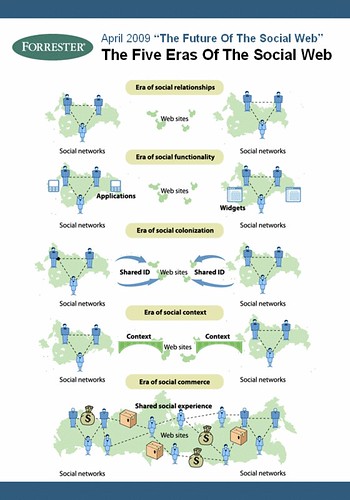
Below the future of social web, as detailed in a research report released by Forresters a few weeks ago.
The Five Eras of the Social Web:
1) Era of Social Relationships: People connect to others and share
2) Era of Social Functionality: Social networks become like operating system
3) Era of Social Colonization: Every experience can now be social
4) Era of Social Context: Personalized and accurate content
5) Era of Social Commerce: Communities define future products and services
Astute marketers will take note and educate themselves now on social media and how it impacts their business and their customer - ahead of the pack.
Read more here
Wednesday
A woman's day in brands
This is so great, I just had to take time out to post it!
Also check out "A man's day in brands"


