
Marketing technology to women is one of my favorite topics!
In this month's newsletter, we take a closer look at what works and what doesn't!
Click here to read!
Friday
Muse newsletter: marketing technology to women.


Thursday
Why social media matters - so much!
The control of products, services and advertising is increasingly shifting to the consumer. Gone are the days of creating an award-winning creative ad and placing it in all the right places. Gone are the days of you telling the consumer what they need. They are telling you. Just ask Motrin or Dell(a).
According to a Forresters research report released recently, "The distinction between traditional and innovative marketing techniques will become significantly more pronounced as the socially driven online communities continue to gain momentum".
...And to quote the CEO of one of Belgium's most aggressively innovative digital TV stations: "The 30" TVC has no future. We have to be realistic and face the fact that it will disappear within the next ten years."
Those are some disruptive theories. But I firmly agree. Marketing as we know it is dead.
I've blogged about it in the post "The death of PR", and will go a step further: social media IS the new PR - especially when marketing to female consumers.
Brands that want to market their products/services to women will need to integrate social media in their marketing strategy.
Why do I place so much emphasis on social media in marketing to women?
Because women treat information gathering as a textured and interactive process – one that includes gathering AND exchanging information – both online and offline - with friends and peers and support networks.
Women also re-evaluate their selection criteria throughout the information gathering process. While men tend to identify a few key selection criteria and then buy a product that matches those criteria to offer them a “good solution”, women will keep adding and amending their criteria - listening to opinions and advice, evaluating your product offering against a complex, nuanced set of criteria - and shop until they find a product that offers “the perfect solution”.
Social media will continue to affect and change the way in which consumers interact, with brands and with each other.
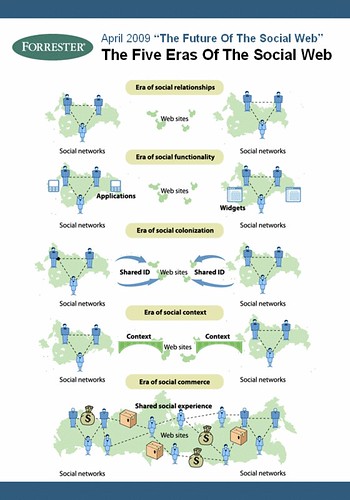
Below the future of social web, as detailed in a research report released by Forresters a few weeks ago.
The Five Eras of the Social Web:
1) Era of Social Relationships: People connect to others and share
2) Era of Social Functionality: Social networks become like operating system
3) Era of Social Colonization: Every experience can now be social
4) Era of Social Context: Personalized and accurate content
5) Era of Social Commerce: Communities define future products and services
Astute marketers will take note and educate themselves now on social media and how it impacts their business and their customer - ahead of the pack.
Read more here
Wednesday
A woman's day in brands
This is so great, I just had to take time out to post it!
Also check out "A man's day in brands"

keychain with GPS. Sound silly? Think again...

When I first read about the keychain with GPS early this morning, I thought "nope...".But that's because I thought about it as answer to the question "where did I park my car?", which made me feel rather stupid.
But the more I thought about it, I realized that it could indeed be very, very handy little gadget.
On a city trip to Prague, for example, as one wanders through unfamiliar streets and neighborhoods and you need to get back to your hotel. Lock in "hotel" as starting point and when needed, it will navigate you back to that point. Or (for the boys) use it to find your tent between a million others at Werchter this year.
The gadget also stores up to 3 locations so you can enter the starting point together with two more on-the-way locations, in effect planning your route back. The gps also has a display with directional arrow, which always points out the general direction you should head in. And, both direction and distance counts down as you move closer to your saved location and counts up as you move farther away.
Barcelona, London, New York, Singapore here I come! With its worldwide range, this little gadget really is a traveler's dream!
Features:
• Tracks up to 32 satellites within 60 seconds.
• Tracking distance up to 9999 miles.
• Store up to 3 locations
• Rechargeable battery USB connection at home, computer, or in your car.
• Highly sensitive GPS receiver provides faster acquisition times and improved tracking capabilities.
• Built in electronic compass that provides bearing information while you’re standing still, always pointing you in the general direction.
• Display directional arrow, direction and distance counts down as you move closer to your saved location and counts up as you move farther away.
• No service fees.
• Global range.
• Smallest personal GPS system that fits on a keychain.
Monday
"It's pretty ugly" - how gender drives our perception of design

Working in marketing and communication for over 10 years now, I can confirm that design is indeed one of the most subjective elements of marketing. And exactly because it's so subjective, its also the most difficult element to discuss with a client, let alone defend rationally if they've decided they don't like it.
How do you defend a design, unless you have facts to back it up?
The lack of research on the effects of gender on design made that one of the biggest stumbling blocks, and we had to rely on arguments such as "from experience" and "as a woman I can tell you that...".
But that's about to change with this book "Gender, Design and Marketing: how gender drives our perception of design and marketing" by Gloria Moss.
In the book, Gloria explores gender preferences in drawing, painting, graphics and web design.
It's a book I'll certainly be buying, and one I'll advise all my clients (from R&D teams to marketing) to buy too!
Here are a few very interesting findings:
- We are drawn to images of people of our own gender
- Women prefer designs with round shapes and detailed surfaces, men prefer linear shapes and plain surfaces.
- Women draw faces in a full frontal position, men draw faces in profile.
- Women prefer the use of more colour, especially bright colours.
- When it comes to website design, men intuitively preferred sites designed by men, and women sites designed by women. (And considering the fact that a whopping 78% of all female orientated beauty sites are designed by men, this may mean that these sites are probably performing below par)
But here's the really interesting bit that should make every brand about to actively engage with its female consumers sit up and take note:
Research points to the fact that women are less accepting of male design aesthetics than men are of female design aesthetics.
And that's not only the case in marketing, but also in product design.
"Although both men and women assign higher scores to own-sex designs compared to opposite-sex designs, men interestingly ascribed higher scores to female-designed products than the women do to male-designed products and this is further evidence of the fact that, given a choice, men have a greater tolerance of the female design aesthetic than women do of the equivalent male aesthetic."
I'm off to order it right now.
Thursday
Proud to be a woman!

Please sit down before you read any further.
See the curvy girl above? She was in the May issue of Harper's Bazaar. Her full size 12 (gasp!) figure on page after page for all to see. (Her name is Crystal Renn, by the way)
Isn't she sexy? I can easily just refer you through to Harper's website, but I like the pics so much, I'll post them here too!
Wouldn't it be great if we saw girls like her more often in our fashion magazines?
Seeing how great she looks makes me feel beautiful and proud to be a woman! 
Kudoz to Harper's Bazaar Australia!
Monday
Much ado about what women want - online.

There's much ado about marketing to women online at the moment.
Articles on what women do (and don't do) online, what's lacking and who's being left out. It seems there is still quite a way to go before we agree we have it figured out.
The article "Men are from Facebook, women are from Twitter", published on CNNMoney.com talks about the different ways in which men and women use the internet. Reading it left me disappointed - some very stereotypical general top-level findings that boil down to "a little bit of this, a little bit of that and a lot of nothing".
Then there was this article about Women over 50 using the internet as primary news source (yup, my mom included!)
The article that raises the most interesting point is this one, by Wall Street Journal columnist Christina Binkley. In it Binkley asks:
"Are online marketers so youth-conscious -- because it feels right -- that they're ignoring lucrative markets just when they're most needed? The Internet is neither new nor young. The fastest-growing segment of Facebook users is women over 55, according to the Tracking Facebook blog. And the underlying assumption that young people are still the Web's most fertile market doesn't hold up to scrutiny."
Food for thought this week!
Friday
Forbidden images
A friend just posted a movie called "Forbidden Images" on Facebook. Not quite knowing what to expect, I clicked "play" and watched closely as the seconds unfolded flickeringly across my screen. Over the next 4 minutes I saw image upon image celebrating women, their exuberant playfulness, their femininity and their sensuality. The images are so hauntingly beautiful it is hard to believe they were once banned...
(This short film was made for the 72-hour Film Festival in Frederick, Maryland (2007). All of the clips used in this film came from a reel of 35mm nitrate, found in an old theater somewhere in Pennsylvania.)
Wednesday
Sex sells chocolate, right?

This launch campaign for "Fling" the new chocolate bar from Mars is raising quite a storm in cyberspace right now.
Everything about this product and it's launch is about sex. And sex sells, right?
The products name: "Fling" (as in "I feel like having a fling with a chocolate bar")
The description of the product: "chocolate fingers"
A tagline that invites you to "Pleasure yourself"
...And then there's the fact that the product's website seems to lead to....a porn site according to this article
Says Lisa Johnson, co-author of Don't Think Pink: "The language of it has so much sexual innuendo, you could pack it into a trashy novel." Johnson says marketers are taking the connection that women often make between chocolate and sensuality too literally. "There are other things you can do that can hit this note without banging on it."
As those of you who know me can attest to, I'm no prude, but all this talk of fingers and pleasuring in relation to a stupid chocolate bar does feel a bit weird. Not only does it shout "trying too hard", it also feels pushy and forced. There's certainly nothing about the product's name, packaging or positioning that makes me remotely want chocolate. And as a blogger commented "that packaging looks to me like a feminine hygiene product. Whoa, pink overload!"
Now that you mention it....
Tuesday
Marketing to women: getting it wrong.

It is still amazing to see how many brands get it wrong in their effort to attract female consumers. I've blogged about Philip's USB-stick necklace before, and now Dell is creating a storm with the launch of their site aimed at women, called "Della".
I'm not sure which consultancy helped Dell develop the strategy for this project (not to mention the look & feel or content of the site), but marketing-to-women wasn't one of their strengths. One of the comments on the "Tech tips" page says it all:
"Does anyone else find that these so called "tech tips" are incredibly simplistic? ... This is a load of fluff that only serves to provide insight into how Dell perceives my demographic. Essentially, we women will buy anything if it comes in pink and fits in our purse. Come on Dell! Treat us like intelligent consumers and not like trained monkeys."
Here are my suggestions to Dell in order to reach their female consumer effectively:
1. Marketing to women doesn't mean marketing to all women.
Before you start, make sure you understand who the women are that buy your product. Who are they? What are their purchase motivators? How does your product integrate in their lives?
2. Gender exclusivity doesn't work.
Women don't demand a separate, overtly female-focused website (that speaks to them in a condescending manner!). Like any consumer, they want ease-of-use, relevant information and respect.
3. Don't stereotype.
And certainly don't 'dumb-down' your message because you think women won't understand. "5 Ways to use a laptop" is an insulting way to speak to any customer, let alone the over-simplified tips that are offered in this section. There's more to women than planning a vacation or going shopping.
My advice? Take the site offline and start all over again. There's no saving this sinking ship.
And as Lydia Sung says: Now if you'll excuse me, I need to give my Asus Eee PC a well-deserved hug.
Subscribe to:
Posts (Atom)


